
A welding procedure specification (WPS) is one of the most important documents in a fabrication workshop. Yet many people confuse it with the PQR and the WPQR. The three terms sound alike, and they work together, but each document does a different job.
Table of Contents:
This guide explains each one in plain English. You will also see how they fit into standards such as ISO 3834 and AS/NZS 3992.
What Is a PQR or WPQR?
Image suggestion: weld test coupon and test report. Alt text: “Weld test coupon used for procedure qualification”.
A PQR (Procedure Qualification Record) is the proof that a WPS works. It records what happened when a test weld was made and tested.
The record includes:
- The actual welding parameters used
- Results of bend, tensile and impact tests
- Hardness and macro examination results, where needed
- The signature of the person who witnessed the test
WPQR means Welding Procedure Qualification Record. It is the term used in ISO standards such as ISO 15614. PQR is the term used in ASME and AWS codes. In practice, they are the same type of document.
WPS vs WPQR vs PQR: Key Differences
Here is a quick comparison.
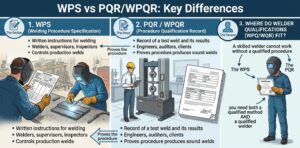
| Document | What it is | Who uses it | Purpose |
|---|---|---|---|
| WPS | Written instructions for welding | Welders, supervisors, inspectors | Controls how production welds are made |
| PQR / WPQR | Record of a test weld and its results | Engineers, auditors, clients | Proves the procedure produces sound welds |
The relationship is simple. The PQR or WPQR proves it, and the WPS tells people what to do. One qualified record can support several WPSs, as long as they stay within the qualified limits.
A WPS without a qualification record has no proof behind it. That is a problem in any audit.
Where Do Welder Qualifications Fit In?
A third document often causes confusion. A welder qualification record (WPQ or WQR) shows that a person can weld to a procedure.
- The WPS and WPQR qualify the method.
- The welder qualification qualifies the welder.
You need both. A skilled welder cannot work without a qualified procedure. A qualified procedure is not enough if the welder is not qualified for that process and position.
Which Standards Apply in Australia?
The requirements depend on your industry and contract. These are the most common:
- ISO 3834: requires fabricators to control welding procedures as part of a quality system. Read our guide to ISO 3834 and fusion welding quality.
- AS/NZS 1554 series: covers structural steel welding and allows certain procedures to be pre-qualified.
- AS/NZS 3992: covers welder and welding procedure qualification for pressure equipment.
- ISO 15609 and ISO 15614: cover WPS content and procedure qualification testing.
- ASME IX and AWS D1.1: often specified on international projects.
Always check the standard named in your contract. Rules for pre-qualified procedures and testing differ between standards.
Common Mistakes to Avoid
Auditors often find the same problems. Avoid these:
- Using a WPS with no supporting record. Every WPS needs a qualification record or an accepted pre-qualified basis.
- Welding outside the qualified range. Changing thickness, process or filler metal may need requalification.
- Poor document control. Old WPS revisions on the shop floor lead to rework.
- Missing signatures or witness details. An unwitnessed test may not be accepted.
- Mixing up procedure and welder qualifications. Keep the two records separate and traceable.
A simple register that links each WPS to its record and to the welders approved for it prevents most of these.
Summary
The welding procedure specification (WPS) tells welders how to weld. The PQR or WPQR proves the procedure works. Welder qualification records prove the person can follow it. Together, they give you consistent welds, easier audits and fewer disputes with clients.
Getting these documents right is a key step toward ISO 3834 compliance and tier-one contracts.
Contact Information
Anybody in need of welding services, please contact us for information. Customers can call our team on 0451 151 786 or email us at yash@iwqms.com.au.